How to balance a hockey ball on a golf tee
The incredible human shoulder.
The shoulder joint is the most mobile in the human body. Whilst the superhero Spiderman had the greatest movie line of all time “With great power, comes great responsibility” For the shoulder it’s more like, “With great mobility, comes great instability” not quite as catchy I’ll admit! However, it remains true and can be equated to balancing a large ball on a small base; a hockey ball on a golf tee.
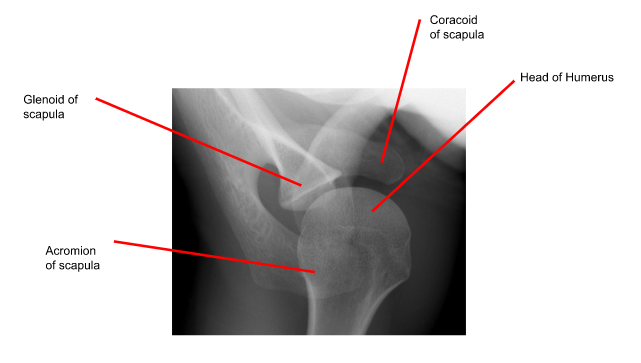
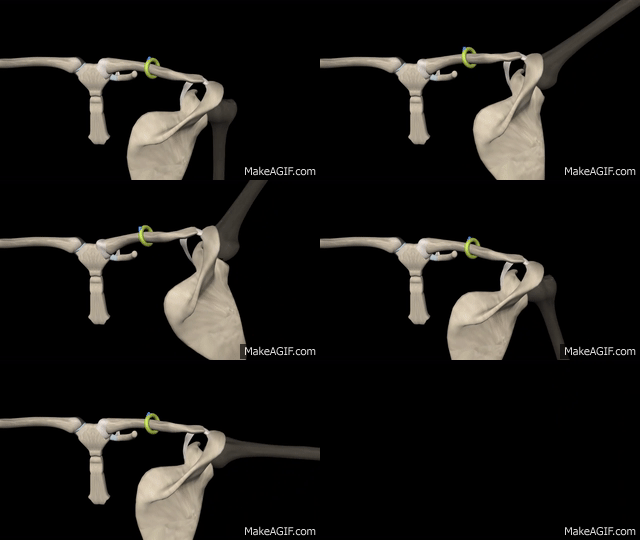
The shoulder girdle is made up of three bones and four joints. The humerus, the arm bone, the scapular, the shoulder blade and the clavicle otherwise known as the collarbone. These bones are joined together with ligamentous structures forming the glenohumeral joint(GHJ), sternoclavicular joint(SC), acromioclavicular joint(AC) and the final one though not a true joint, the scapulothoracic joint(ST). All of these joints must work together to produce the wide range of movements of flexion, extension, abduction, adduction, medial and lateral rotation, horizontal flexion and circumduction(a combination of all movements).
An example: In a healthy shoulder the standard range of motion of the GHJ to abduct the arm, raising the arm out to the side, is from 0 to 90°. So really no higher than your chin, but we can take our arms all the way out to the side and overhead. So how do we do it? The GHJ is made up of the glenoid of the scapular and the head of the humerus, making the classic ‘ball and socket joint’ so what the body does; it moves the position of the scapular, by upwardly rotating the scapular so that the glenoid faces skywards. However to do that the AC joint and SC joint have to move too. Therefore a movement of simply taking your arm out to the side and overhead requires the use of 4 joints and even more muscles.
When pitching a tent, use guy ropes
To maintain mobility and stability of the shoulder, the body has many muscles to facilitate this. Some of the most important of these are the rotator cuff muscles. Most people know of the rotator cuff but many don’t know what they do. The rotator cuff consists of four muscles, supraspinatus, infraspinatus, subscapularis and teres minor. Complicated names for something with a relatively simple role. These muscles arise from the scapular and attach to the head of the humerus, forming a cuff of connective tissue. These stabilise the joint and maintain the position of the humeral head central to the socket.
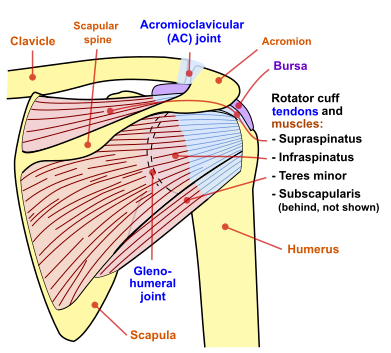
With our shoulder abduction example, what happens at the rotator cuff? As the shoulder abducts the head of the humerus moves upwards, which would threaten the head to roll off the socket! To prevent this, the infraspinatus and teres minor pull downwards, sliding the head of the humerus to stay in the shallow socket. If the humerus doesn’t glide downwards, the tendons of the bicep, supraspinatus and the fluid-filled sac known as a bursa can get trapped, this is known as shoulder impingement and can be very painful.
These muscles act like guy ropes on a tent, or the cables of a suspension bridge. They are allowed to move but they stabilise the structure and prevent you from having a very disturbed sleep!
Maintaining healthy shoulders is incredibly important as we use our shoulders for everything which affects quality of life. Shoulder pathology is extensive due to the number of structures in this area but exercises to maintain rotator cuff health are simple and easy to do as part of a warm-up before the gym or at home whilst watching TV. Speak to your doctor, physiotherapist or other health care professional if you are suffering from shoulder pain. Speak to your local gym instructor, personal trainer, physio or coach for help with maintaining the health of your rotator cuffs.
Always remember, local strengthening has its place but once some function has returned to an injured shoulder, global movements are the key to maintaining shoulder function, like bench press, shoulder press, face-pulls, prone flys, serratus punches, and press-ups. The list goes on and on.