What is knee valgus and should we be worried about it?
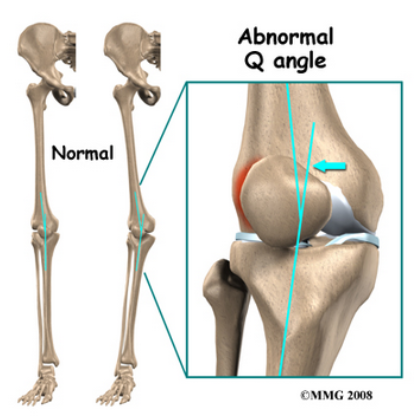
Valgus refers to a force that pushes inwards toward the body’s midline according to Cleveland Clinic(2023). Essentially if a body part tends to point or move towards the centre of the body can be referred to as being ‘valgus’. It can sometimes be described as an unnatural position as usually it refers to the alignment of joint and bone structures. In the case of this blog, we are talking about the inward turning of one’s knees. Known colloquially to the lay person as being ‘Knock-kneed’, knee valgus can be present in normal standing or when doing exercise such as squatting, running, lunges etc. Other sources argue that knee valgus is actually the angling of a bone or joint outwards away from the body, see Fig.1(Valgus Knee, 2008). The arrow denotes the valgus as the distal(lower) leg the angle running away from the midpoint. In layman’s terms, when the tibia internally rotates and the femur externally rotates it forces the ‘knock-knee’ look.
When considering knee valgus and the chances of injury risk, we should consider the structures that are loaded. Inside the knee joint, the medial meniscus is under comparatively higher compressional forces compared to the lateral side. Logically, when the tibia rotates on the femur during cutting movements this can increase the risk of meniscal injury. 85% of male football players suffered with Anterior Cruciate Ligament(ACL) injuries(Waldén et al., 2015). The ACL arises from the posterior medial wall of the lateral femoral condyle and attaches to the centre of the anterior portion of the tibial plateau and is designed to stop anterior translation of the femur and excessive rotational loads.
The ACL comes under high tensile loads with an internally rotated tibia and when coupled with an anterior shearing force, can cause a non-contact ACL injury ‘non-contact’ refers to when there is no physical contact in that area; this can be caused by rapid changes of direction and landing phase of a jump with a mostly straight leg(Waldén et al., 2015),(Koga, 2016).
Increased tensile loading on the MCL, in these same positions increases injury risk.
Quite often these three subjects get damaged at the same time, due to the high loads placed on the medial knee structures, this is known as the ‘unhappy triad’. However, some argue the there is potential for a lateral knee meniscus injury (Amir Human Hoveidaei et al., 2023). ACL injury is 2.2x higher in females(Montalvo et al., 2018) which could be attributed biomechanically at least to a greater Q-angle in a female(Douglas C.A. Taylor & Bevier, 2023) which could be due to a wider pelvis.
As discussed in a previous blog “How special does special rehab have to be?” Loading the tissues into these positions is important for building resilience and help prevent recurrence of injury. However, proper queuing of techniques is important to maintain not just a safer alignment and correct activation of muscles and improve sport performance.
When attempting to rehabilitate someone from an injury, loading the injured structures into the mechanism of injury is important from a sports specific perspective. Doing this in a gym situation can be difficult to find a way that is close to the intensity and specificity for the sport. Employment of the control-chaos continuum can be used to help ensure robustness during sport and everyday life This continuum focusses on starting in a controlled environment such as a predictable straight line run with a define structure with no changes of direction and then gradually adding various chaotic elements to simulate a sporting situation such as high speed running with rapid accelerations, decelerations and changes of direction(Taberner et al., 2019).
When programming the for sport consider the various movements of the sport and consider the planes of motion that are moved through. If we examine the act of walking, getting into a car or filling the washing machine. We don’t move purely through a singular plane. These are complex movements but are considered extremely simple. When we train in the gym a large proportion of exercises are locked in the sagittal plane, like a squat, deadlift, forward/backward lunge. Even powerful olympic lifting derivatives that are used and considered some of the best exercises for athletic performance are locked into the sagittal plane so can we truly use these exercises as the gold standard for sport performance?
While olympic lifting has its place in force production and attenuation, to form a well rounded workout program for sports and for the average person multi-planar movements should be considered. Adding a rotation element to your lunge or adding frontal plane stability challenges with off-set loads like grave-digger deadlifts or suitcase carries. FInally with rotational loads, anti-rotation can also be employed with multi-planar movements, a Pallof press with body-weight squat can be used and apply unconventional loads that can be used to build robustness.
References:
Amir Human Hoveidaei, Reza Sattarpour, Haleh Dadgostar, Razi, S., & Razi, M. (2023). Unhappy triad of the knee: What are the current concepts and opinions? World Journal of Orthopedics, 14(5), 268–274. https://doi.org/10.5312/wjo.v14.i5.268
Cleveland Clinic. (2008). Valgus and Varus Stress Tests. Cleveland Clinic. https://my.clevelandclinic.org/health/diagnostics/25145-valgus-and-varus-stress-tests
Douglas C.A. Taylor, & Bevier, C. R. (2023). Relationships Among Knee Injuries, Q-angles, and Competition Levels in Female Ski Racers. MedRxiv (Cold Spring Harbor Laboratory). https://doi.org/10.1101/2023.09.14.23295552
Koga, H. (2016). Mechanisms for Noncontact Anterior Cruciate Ligament Injuries: Knee Joint Kinematics in 10 Injury Situations from Female Team Handball and Basketball – Hideyuki Koga, Atsuo Nakamae, Yosuke Shima, Junji Iwasa, Grethe Myklebust, Lars Engebretsen, Roald Bahr, Tron Krosshaug, 2010. The American Journal of Sports Medicine. https://journals.sagepub.com/doi/abs/10.1177/0363546510373570
Taberner, M., Allen, T., & Cohen, D. D. (2019). Progressing rehabilitation after injury: consider the “control-chaos continuum.” British Journal of Sports Medicine, 53(18), 1132–1136. https://doi.org/10.1136/bjsports-2018-100157
Valgus Knee. (2023). Physiopedia. https://www.physio-pedia.com/Valgus_Knee#/media/File:Q_angle.png
Waldén, M., Tron Krosshaug, Bjørneboe, J., Thor Einar Andersen, Faul, O., & Hägglund, M. (2015). Three distinct mechanisms predominate in non-contact anterior cruciate ligament injuries in male professional football players: a systematic video analysis of 39 cases. British Journal of Sports Medicine, 49(22), 1452–1460. https://doi.org/10.1136/bjsports-2014-094573